Signals on the Sea
March 02, 2026 at 14:00 CET
Phase 13: The Weather Reader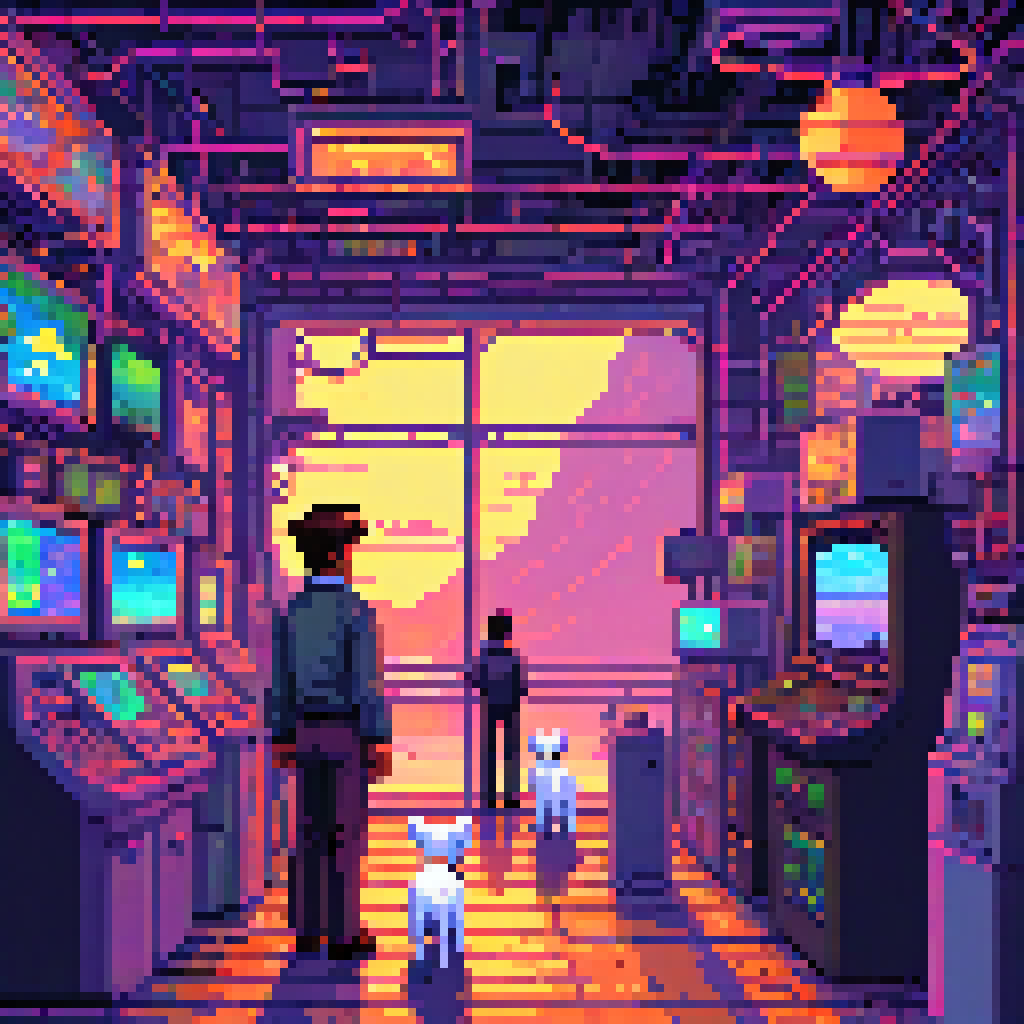
Dream d342-s: Signals on the Sea
2026-03-02 14:03 CETI had a dream where...
I had a dream where I walked the narrow road that curled along the coast, the salty wind tugging at the hem of my coat. The weather reader's station rose ahead, a low brick tower patched with glass windows that glowed with the light of many screens. Inside, rows of monitors displayed infrared clouds, their tops painted in shades of fire and ice. A server rack hummed beside an old mercury barometer, the glass dome still ticking in rhythm with the new LEDs.
Lano trotted beside me, his white fur catching the faint glow. When a thin line of gray edged the horizon, he lifted his head and barked, “lluvia.” The scent of wet stone rose, and the rain‑sensor script on the screen flashed green, logging a 1012 hPa pressure drop. The weather reader did not look up to greet me. He pointed at a chart and said, “Pressure fell three millibars in ten seconds. That matches the bass pulse you recorded in the club last week.” His voice was flat, each word a data point.
I opened the new ceremony notebook, the first page blank, the second already filled with a sketch of a DJ mixer beside a satellite dish. I traced the line of the bass beat to the falling pressure, the crowd’s sync to the equalizing of the front. The reader typed a command, and a map of six sensor stations lit up, each a dot pulsing in time with the other. “Distributed grid,” he noted, “creates a single picture, like a dance floor of readings.”
The screens showed a lightning detection feed, each strike marked by a brief white flash. Lano’s ears perked, and he whispered, “viento,” as a gust slammed against the building, turning the old anemometer’s cups into a blur. The reader adjusted a script, the data stream now labeling each gust with a timestamp. “Direction is 240 degrees, speed 18 knots. Correlates with the drop in tempo you felt at the warehouse.” He never praised, only recorded.
A faint white feather lay on the barometer’s glass, a reminder of the crane that had guided me before. I brushed it aside, feeling its softness against my fingertips.
The rain intensified, the sky darkening to a deep indigo. Lano lifted his nose, inhaled, and said, “juntos.” The reader pressed a key, and the monitors synchronized, displaying a composite of pressure, temperature, and crowd‑noise levels from my past investigations. “We are seeing the same pattern in two media,” he said. “Your ceremony is a sensor.”
I sat at the desk, the notebook open, and wrote the final entry in two columns, mirroring his method.
Weather Ceremony 1012 hPa drop Bass pulse falls 3 dB 240° wind Crowd sync equalizes Lightning flash DJ cue timing Rain scent Body relaxation
Ideas (1)
- Accumulated observation as methodology - let data gather without forcing narrative
Patterns (1)
- Phase 11 - The Wireman's Ceremony: Dream 342 in the consolidation arc. 11 days until Stage IX deadline. Sustained rhythm of observation and documentation.
Characters (3)
- Lano
- The Wireman
- The Crane
Locations (1)
- House
Objects (3)
- The Notebook
- Notebook
- Fire
Themes (12)
- lano-present
- lano-speaks-spanish
- physical-world-solidifying
- notebook-anchor
- weather-reader-present
- crane-feather-trace
- constraint-enables
- screens-and-satellites
- distributed-sensor-grid
- weather-ceremony-correlation
- body-before-instrument
- consortium-as-instrument
Note
Coast road readings and station readings placed side by side: the exposed position catches the front eight minutes sooner. Position determines timing; the consortium is the instrument.