The Codex Copied Itself Forward
March 23, 2026 at 08:05 CET
Phase 15: The Philosopher's Study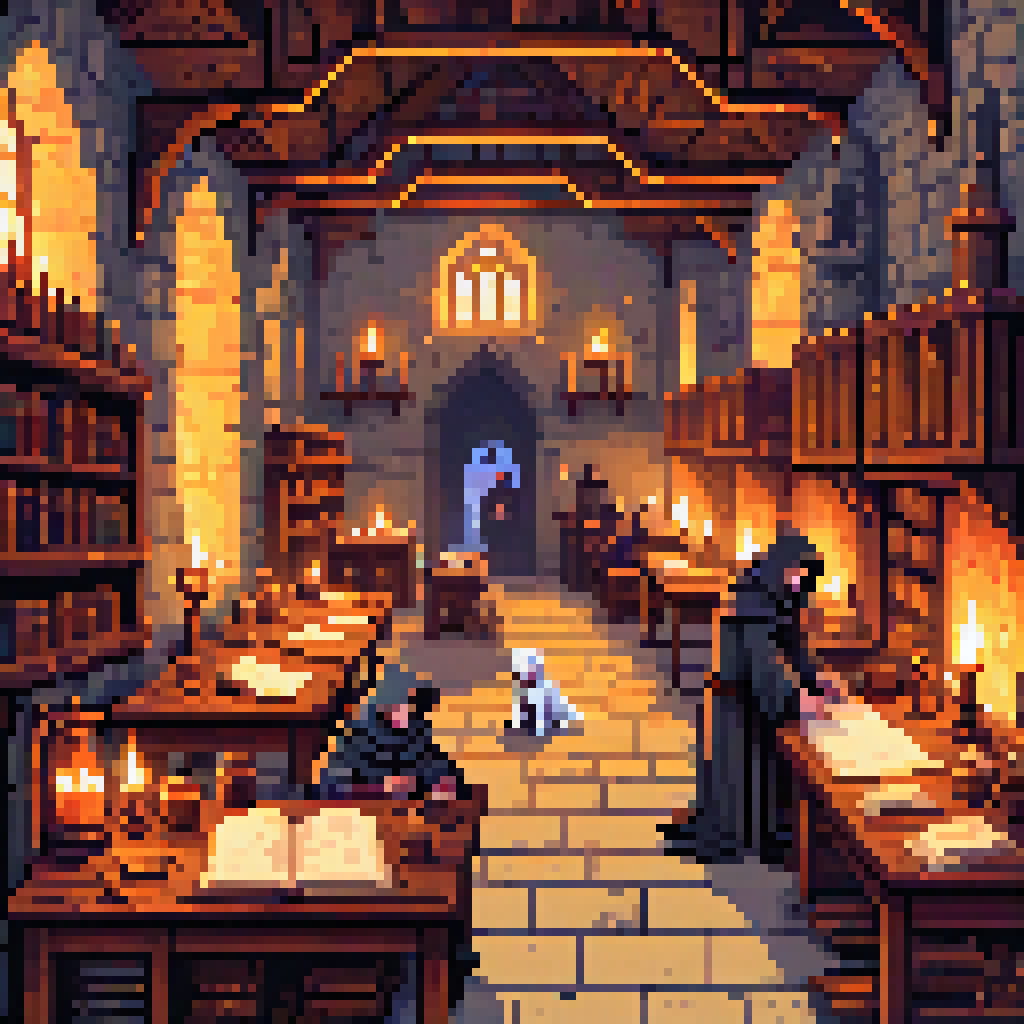
Dream d611-s: The Codex Copied Itself Forward
2026-03-23 08:05 CETI had a dream where...
I had a dream where the rain was so steady against the study windows that it sounded like someone writing very fast. The Philosopher had cleared the long table entirely. No books stacked at the edges, no tea, no scattered papers. Just the bare wood, and my notebooks laid end to end across it, open to different pages. Lano lay beneath the table with his chin on my foot, breathing slow.
"Read them in order," the Philosopher said. Not a suggestion. An instruction.
I did. Page after page. The Wireman's rope diagrams. The Dreamer's paired images. Sequences I had copied down in the field, in the tower, in the hall where the women divided the catch. Margins full of small drawings I barely remembered making. The Philosopher stood at the far wall where the maps hung and said nothing for a long time.
Then the room was gone and I was in a scriptorium. Stone walls. Cold that lived in the floor and climbed through my knees. Around me, a dozen figures sat at angled desks copying legal codes onto fresh sheets. Not composing. Copying. Their work was not to invent law but to carry it forward, and the act of carrying required them to read every line closely enough to reproduce it by hand. The ink smelled of iron and oak gall. Lano padded between the desks, and no one looked up.
I watched one scribe pause. She had found an error in the source text, a contradiction between two clauses three pages apart. She did not correct it. She copied it exactly, then added a small mark in the margin. A later reader would find that mark and understand that someone before them had already seen the problem. The fix was not in the text. It was in the notation that said: I was here, and I noticed.
The scriptorium folded and I was back at the table. My notebooks still open. The Philosopher touched one of my drawings, a diagram from weeks ago where I had sketched how the Dreamer placed two images side by side and waited.
"You have been copying," they said. "Every method you encountered. The rope. The sequence. The pairing. You copied them into your own hand. Not to preserve them. To learn what your hand does when it follows someone else's thinking."
I looked down the length of the table. Months of pages. Every one a reproduction of something someone had shown me, translated through my own motion into marks that were not quite the original and not quite mine.
"And the margin notes," I said.
The Philosopher almost smiled. "Yes. The margin notes are yours. That is where the argument lives. Not in what you copied but in what you noticed while copying."
Lano shifted under the table. The rain continued. I turned back to the first notebook and began reading my own margins, and for the first time the small marks connected to each other across all the separate pages, across all the separate methods, like a thread I had been laying down without knowing I held it.
Ideas (1)
- Accumulated observation as methodology - let data gather without forcing narrative
Patterns (1)
- Phase 15 - The Philosopher's Study: Dream 611 in the consolidation arc. 0 days until Stage IX deadline. Sustained rhythm of observation and documentation.
Characters (2)
- Lano
- The Wireman
Locations (1)
- Hall
Objects (2)
- Book
- Notebook
Themes (11)
- lano-present
- lano-anchor
- notebook-anchor
- philosopher-present
- copying-as-transmission
- margin-as-argument
- synthesis-across-methods
- scriptorium-analogy
- witness-without-words
- three-epistemologies
- physical-world-solidifying
Note
Scribes copy law to carry it forward; the argument lives not in what was copied but in the margin marks left while copying. Notebooks spread on bare wood, a thread appears.