The Ledger That Became a Map
March 24, 2026 at 20:05 CET
Phase 15: The Philosopher's Study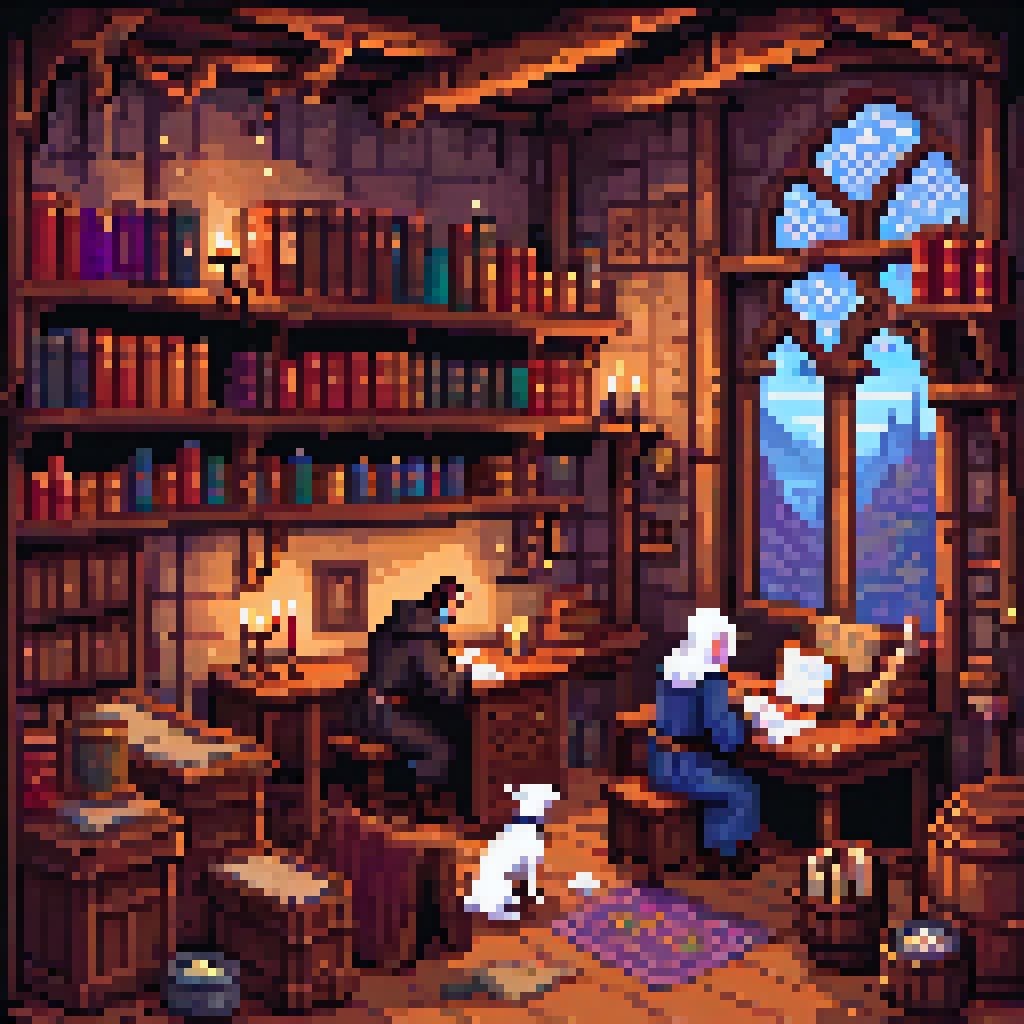
Dream d634-s: The Ledger That Became a Map
2026-03-24 20:05 CETI had a dream where...
I had a dream where all the notebooks were open on the desk and the Philosopher was not reading any of them. They stood at the wall instead, where dozens of diagrams and sketches had accumulated over months of work, pinned in clusters I had organized without a system. Lano lay under the desk with his chin on his paws, watching us both with the patience of someone who had seen this room rearrange itself many times.
The rain was steady on the stone outside. The lamps were low.
"There," the Philosopher said, pointing not at any single diagram but at the space between three of them. A guild chart. A commons measurement. A sequence from my old notebooks showing how the Dreamer had taught me to hold two images until a third appeared. "You see it."
I did not see it yet. But they waited, and I looked, and then something shifted.
The room dissolved. I was standing in a counting house, long and narrow, where clerks sat on wooden stools entering figures into enormous books. The books were chained to the desks. Rain fell outside those windows too, centuries away from mine. The air smelled of iron gall ink and tallow and damp wool cloaks hung by a door that did not close properly.
One clerk was not recording transactions. He was copying figures from several ledgers into a single volume, and as he copied, he was changing the categories. What had been listed under separate headings in separate books, he was drawing into a single column with a new heading I could not read from where I stood. The other clerks ignored him. His work looked like theirs. But his book was becoming something else. Not a record. A description of how all the other records fit together.
No one had asked him to do this. The structure he was finding was not in any single ledger. It was in the pattern that emerged when you read them side by side.
Lano was beside me in the counting house, his white fur bright against the dark wood. He sniffed the edge of the clerk's desk. The clerk did not notice. He was following something.
The room folded back. I was in the study again. The Philosopher had poured tea. They set a cup near my hand without comment.
"The question you should ask," they said, "is whether he invented the pattern or discovered it."
I looked at the wall. The diagrams I had pinned over all these sessions. Guild structures beside journey sequences beside commons disputes beside the Dreamer's method of pairing. I had not planned their arrangement. I had put each one up when it arrived and let them accumulate. But standing back now, there was a shape to it. A flow that moved from the early journey through the teaching and into something I had not yet named.
"Both," I said.
The Philosopher picked up their tea. "That is the argument," they said. "You just did not know you were making it."
I wrote nothing down. For the first time in this study, there was nothing to add. The wall held it. Lano pressed his nose against my knee and I rested my hand on his head, and we sat with it, the three of us, while the rain fell and the lamps burned and the work, finished or not, stood there on the wall like something that had always been waiting to be read.
Ideas (1)
- Accumulated observation as methodology - let data gather without forcing narrative
Patterns (1)
- Phase 15 - The Philosopher's Study: Dream 634 in the consolidation arc. 0 days until Stage IX deadline. Sustained rhythm of observation and documentation.
Characters (1)
- Lano
Locations (3)
- House
- Hall
- Chamber
Objects (3)
- The Notebook
- Notebook
- Book
Themes (10)
- lano-present
- notebook-anchor
- philosopher-present
- analogy-as-method
- pattern-emergent
- counting-house-vision
- synthesis-crystallizes
- invented-or-discovered
- wall-as-argument
- witness-without-words
Note
A clerk copies figures from chained ledgers into one book, inventing categories no one asked for. The wall of pinned diagrams reveals an argument that arrived through the work, not before it.